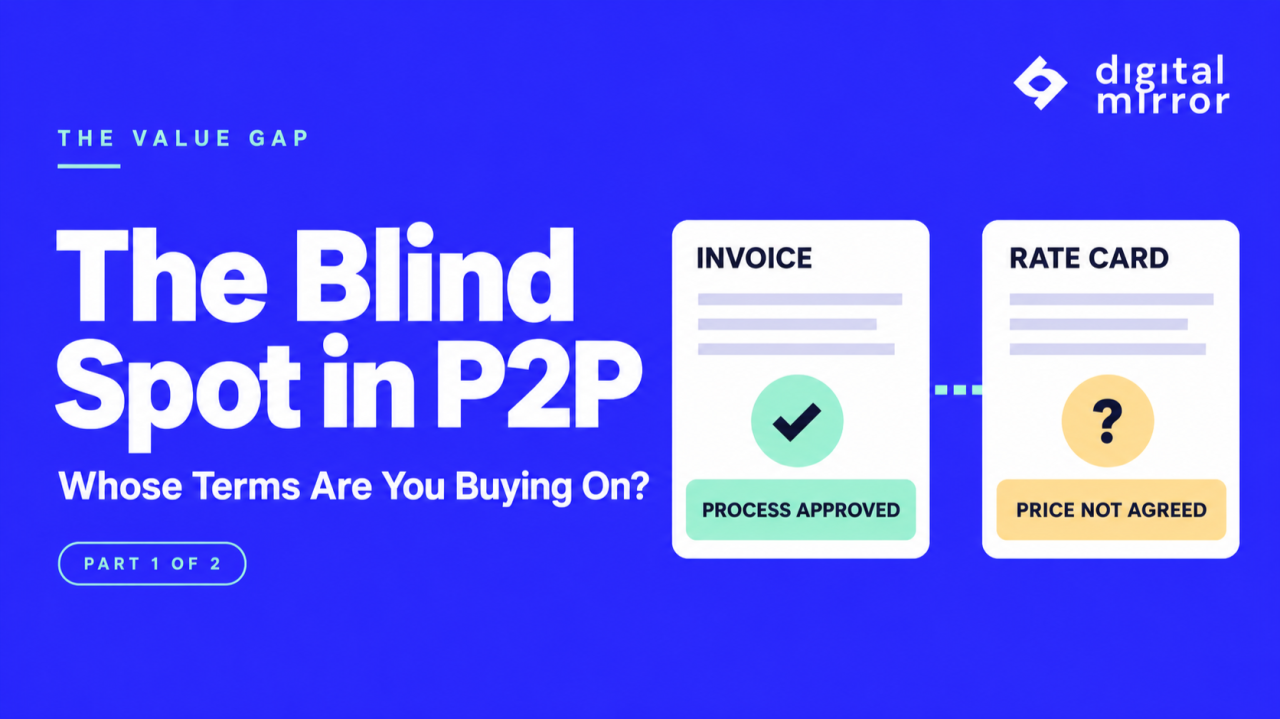
The Blind Spot in P2P: Five More Kinds of Loss
Discover hidden risks in P2P processes that lead to value loss and learn how to align contracts with invoices to recover savings effectively.
• 6 min read
Executive Summary
In the last edition of The Value Gap we set out the first five of ten kinds of loss between a contract and an invoice: overcharging, calculation errors, purchases outside the agreement, purchases that fell out of it, and prices nobody with authority approved. Most organizations look for only the first two. This edition covers the other five, explains why the systems already in place miss most of the ten, and shows where Digital Mirror fits. The question behind all ten is the same: whose terms are you buying on?
Five More Kinds of Loss
The remaining five complete the Absence group and add the third group, Overspill. Each comes with an example from our work with prospects and customers.
Absence. Nothing was agreed that settles what the charge should be, or the fact that settles it is not on the invoice.
- Never defined: The contract prices by a measurement it never defines, so the supplier's figure decides which price band applies. In one engagement, over 300 charges, worth about $19,000, were billed in a higher defect band than the jobs' own figures support. On one job, the measurement was zero defects.
- Missing band: The bands leave a hole, so a real value has no agreed price. For example, bands set at 0 to 10% and 10.5 to 20% leave no price for a delivery that arrives at 10.4%. A hole like this can appear when an amendment adds a band, and nobody rechecks the others.
- Never on an invoice: The money depends on a fact no invoice shows, such as a rebate threshold. One parcel customer's annual spend was just over $6M, against the next discount tier at $6.5M, worth about one percentage point on every service. Nothing on any single invoice shows how close it was.
- Cannot be traced: The document, table, or link needed to check the charge is missing. In one engagement, three shipments worth about $4,500 were priced by weight from a table that was not among the documents, so nobody could check them.
Overspill. There is more of it than anyone can check.
- Cannot be checked: Everything exists, but there is too much of it for any team to check. One construction company receives 15,000 invoices a quarter. Another business has 21,000 invoice lines a year to check against 16 rate cards.
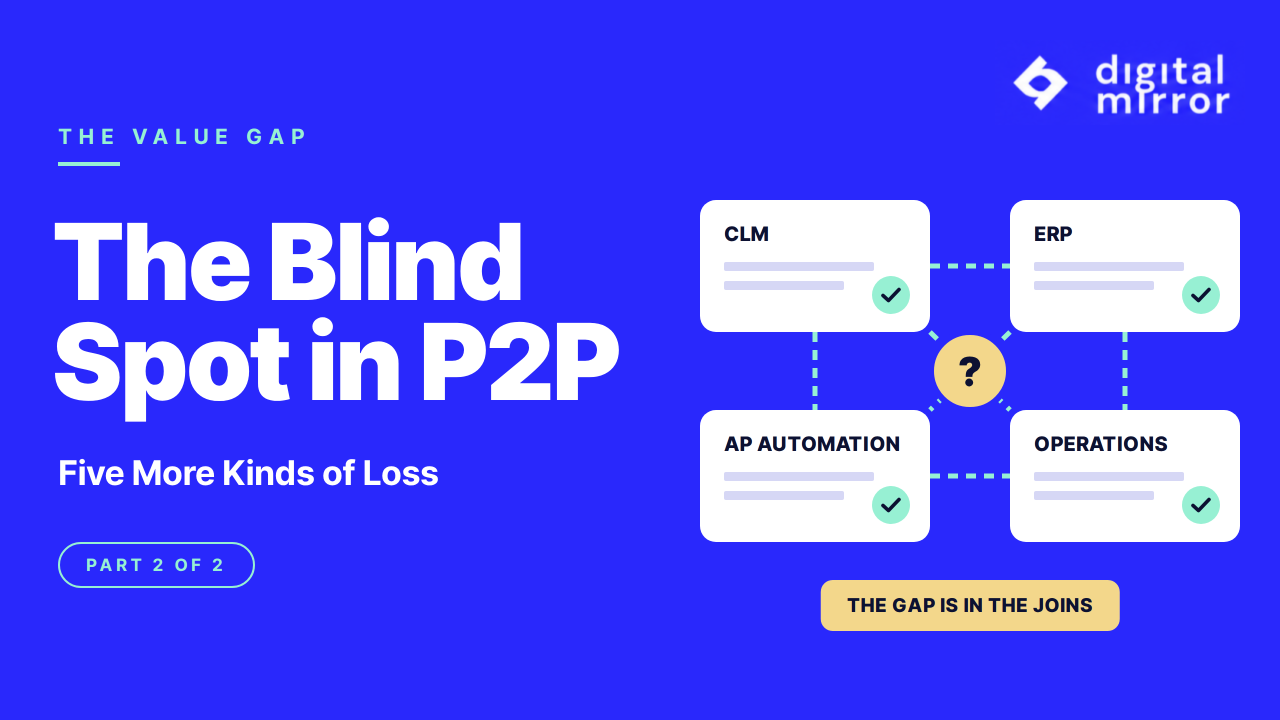
The Blind Spot Is in the Joins
Most organizations already have technology for each step between signing a contract and paying an invoice. Contract lifecycle management (CLM) systems manage contracts. Procurement platforms manage sourcing and purchasing. ERP systems hold transactional and master data. AP automation processes invoices. Operational systems record what was delivered or consumed, and recovery auditors look afterward for money that escaped earlier controls.
Each does its job. But whether a charge is right often depends on information held in several of them at once.
The contract might set the pricing rule, an amendment its effective date, an operational system the measurement that sets the price, and the invoice the amount charged. Nobody can say whether the charge is right until those pieces are brought together.
What is missing is a single record that links the agreement, the version in force, the event that triggered the charge, the pricing rule that applies, and finally the invoice and the payment.
The blind spot exists not because organizations lack systems, but because it sits in the joins between them.
What Automation Should Be Checking
AI, AP automation, and e-invoicing make the underlying data much easier to work with. Organizations can automatically extract invoice data, process structured invoices, and use AI to read contracts. None of this settles whether the price was right.
A structured electronic invoice can still carry a price that was never agreed. Three-way matching can confirm that an ordered service was received without proving that the price behind the PO was valid. A contract AI system can extract a pricing clause without knowing whether the operational data later used to calculate the price was correct.
Nor can AI create certainty where the contract is silent. If the parties never defined what "volume" means for a volume-based price, the answer is to find that gap and settle it with the supplier. A model asked to guess what the parties meant will produce a guess.
The opportunity for automation is to test every charge, as it arrives, against the agreed rules and the operational evidence.
Where Digital Mirror Fits
Digital Mirror starts from a different view of the contract: a set of commercial terms that should be reflected in what is paid. Our work is checking whether they are.
That begins with finding out what agreements exist. Contracts, amendments, and related documents end up scattered across shared drives and other systems as organizations restructure, acquire businesses, and change staff. Digital Mirror's Discovery Agent finds this material and distinguishes active contracts from amendments, duplicates, and expired documents.
The contract that applies to a given invoice is rarely one document. It is the original agreement, changed by every amendment and rate card since. Digital Mirror puts these documents in date order and builds a contract timeline, showing which terms were in force on any given day. Each invoice can then be checked against the terms that applied on the charge date.
Once the timeline is built, the work is to connect it to what is being paid. Digital Mirror describes capabilities including checking pricing against catalog and discount schedules, identifying inaccurate invoices, finding rebates and credits, mapping external data sources, monitoring supplier obligations and KPIs, and continually reassessing contract and supplier performance.
Digital Mirror does not replace P2P, ERP, AP automation, or CLM. It works alongside them, connecting what the organization negotiated with what happens afterward.
The aim is to find out why payments have moved away from the agreement, put a figure on it where possible, and turn each finding into a lasting control, without adding another queue of exceptions for accounts payable to work through.
The Question for CFOs and CPOs
Finance and Procurement usually come at this problem from opposite ends. Procurement focuses on getting the agreement right; Finance focuses on controlling what gets paid. Between the two is a supplier relationship in which prices, products, volumes, measurements, and circumstances keep changing.
Our work suggests this middle ground should be controlled in its own right.
Matching the invoice to the PO remains valuable. However, the organization also needs to know that the PO, the pricing rules behind it, and the operational evidence still reflect what was agreed.
For CFOs and CPOs, the question is no longer only whether the invoice passed the P2P process. It is whether the business can show that what it paid is justified by what it agreed.