


Explore the hidden risks in P2P processes, revealing how unnegotiated terms lead to value loss between contracts and invoices. Understand the ten types of loss.
Executive Summary
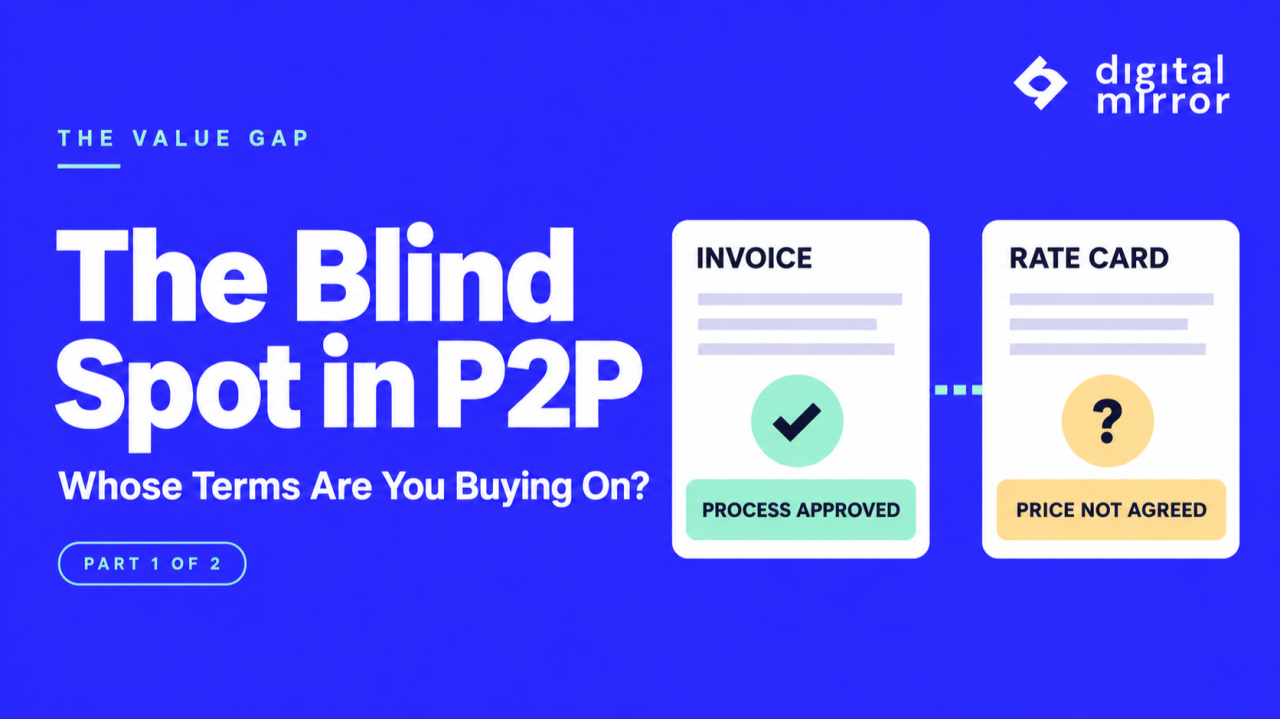
Although procure-to-pay (P2P) controls have become considerably more sophisticated over the past two decades, they still answer only one question: did the transaction follow the process? What our work with prospects and customers has found is that an invoice can pass every P2P check, from an approved supplier to a perfect three-way match, and still charge a price nobody agreed on. When that happens, the business is buying on terms it never negotiated, usually the supplier's own. That raises a question every finance and procurement leader should be able to answer: whose terms are you buying on? We have identified ten kinds of loss between a contract and an invoice, and only two of them are the mistakes most organizations look for. In this edition of The Value Gap, we set out the first five. The next edition covers the other five, why the systems already in place miss them, and where Digital Mirror fits.
The P2P Gap
Purchase orders (POs) establish authority before expenditure is committed, three-way matching connects orders with receipts and invoices, and accounts payable (AP) automation can now process enormous transaction volumes with relatively little human intervention. These advances have removed many of the errors and control weaknesses that once characterized accounts payable.
However, a transaction can satisfy the requirements of the P2P process (the supplier is valid, the purchase was authorized, the goods or services were received, and the invoice matches the PO) without establishing that the amount being paid is commercially correct according to the terms of the contract. As a result, the process can work exactly as designed while still allowing value to leak between the negotiated agreement and the payment made.
This is a gap between transactional correctness and commercial correctness. P2P can provide strong assurance that a transaction followed the prescribed process, but it does not ensure that the commercial assumptions embedded in the transaction match what the organization actually agreed.
The Invoice Is Correct, but the Price Was Never Agreed
Consider a straightforward example. A supplier provides a service, the business consumes it and the supplier invoices the correct quantity at its published list price. The invoice calculation is accurate and matches the corresponding PO perfectly. This might seem like a success story, but there is a problem: nobody ever negotiated a contract price for that service.
Nothing necessarily went wrong in AP. Indeed, the supplier may not have done anything wrong either. The problem occurred earlier, when commercial activity moved beyond the agreement's boundaries, and nobody detected the change.
A second example makes the distinction even clearer. Eleven product lines were billed for an entire quarter using rates contained in a rate card tab marked "To Be Confirmed." The supplier applied those rates consistently, and the calculations were correct, but the prices themselves had never actually been agreed.
These are difficult problems for conventional invoice controls because there may be no erroneous invoice field to identify. The invoice faithfully reflects the pricing basis being used operationally; what is missing is evidence that anyone with authority agreed to it.
That distinction also explains why looking only for conventional overpayments can produce an incomplete picture of leakage. In one parcel engagement, identifiable overcharging represented only 0.05 percent of the monthly spend examined. The value associated with services being purchased at list price because the agreement contained no price was more than 100 times larger.
This shows the difference between searching for invoice errors and examining the broader integrity of the commercial transaction.
The Business Gets Ahead of the Contract
The initial contract is usually clear enough. There is an agreed scope, an agreed rate card and a set of contractual mechanisms governing how the relationship should operate. But as the months and years pass, commercial reality and the signed agreement begin to diverge. New products and services are added, volumes change, business units are acquired, and supplier codes are changed. Temporary arrangements keep operations running. Someone circulates a revised spreadsheet while an amendment is still being negotiated. Operational systems begin capturing measurements that determine price, while the original contract remains static in a repository.
The First Five Kinds of Loss
The ten kinds of loss we have identified are different manifestations of this underlying problem. They fall into three groups: Error, Absence, and Overspill. Here are the first five.
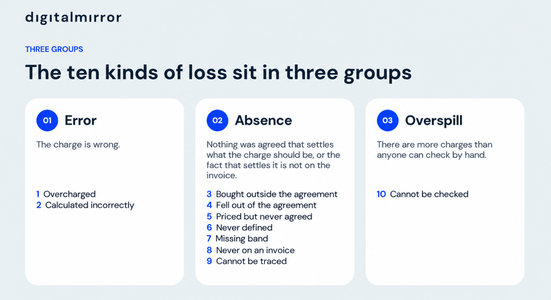
The first type of loss: Error. The charge is wrong.
- Overcharged. An agreed rate exists, and the invoice charges more than it.
- Calculated incorrectly. The invoice contradicts itself.
The second type of loss: Absence. Nothing was agreed that settles what the charge should be, or the fact that settles it is not on the invoice.
- Bought outside the agreement. No agreement covers the item, so the supplier's own price applied.
- Fell out of the agreement. The item was covered, but something mechanical put it outside, such as a changed code or an expired contract.
- Priced but never agreed. A rate is in use that nobody with authority signed.
This is why describing everything as an "overpayment" is misleading. Overcharging can be compared directly with an agreed rate, and a calculation error shows on the invoice itself, so both can be recovered. Many of the others are poor terms the supplier was entitled to charge, or charges where the agreement gives no clear answer. Finance should not account for, report, or pursue them in the same way.
In the Next Edition
The other five kinds of loss include charges that depend on a fact no invoice shows, and charges that could be checked but are not, because there are too many of them. We will set them out, explain why the systems already in place miss most of the ten, and show where Digital Mirror fits.