Between the Signature and the Invoice
Discover how unnegotiated terms in P2P processes lead to value loss between contracts and invoices, and learn to recover what is often overlooked.
• 5 min read
Executive Summary
Most organizations negotiate well. They invest in sourcing strategy, run competitive bids, and sign contracts with pricing tiers, rebate structures, and performance commitments that look strong on paper. The difficulty arrives afterward, in the quiet stretch between the signature and the invoice, where those terms are meant to become the amounts you actually pay.
That is where value tends to go missing.
The Symptoms are Well Documented
In Cleo's 2026 Global Supply Chain Executive Report, a survey conducted by Dimensional Research found that 65% of companies losing revenue to supply chain problems attributed the loss to broken service-level agreements, chargebacks, penalties, and deductions, with the damage typically ranging from 2% to 5% of revenue. These are ordinary failures, the everyday friction of commercial relationships that nobody watches closely once the deal has closed.
It helps to understand the mechanism because it explains why careful organizations are exposed too. Every layer of sophistication that procurement negotiates into a contract has to survive a journey through your systems before it reaches an invoice. The tiered rate, the volume rebate, the SLA credit, the index-linked escalator, and the usage true-up: each is a precise instruction about what you should pay under particular conditions. The purchase order carries almost none of it. A PO is a lossy copy of the contract; it keeps the quantity and the headline price and quietly sheds the conditions that made the deal worth signing in the first place.
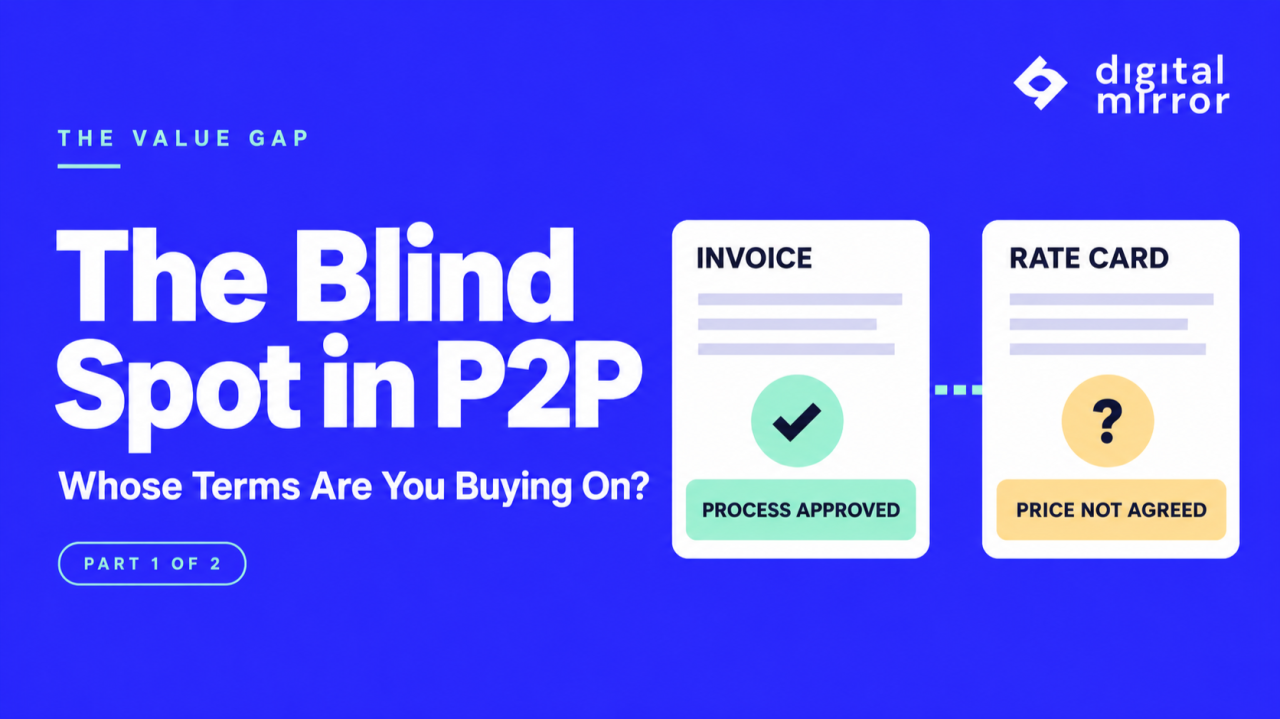
Finance then does exactly what a good process demands. It checks the invoice against the purchase order; if the two agree, the invoice is approved, and payment is sent. The control works perfectly, but the payment can still be wrong because the purchase order was never the correct reference. The contract was. An invoice can satisfy every check in your accounts payable process and bear almost no relation to what you actually agreed.
This is Why the Gap is so Easy to Miss
Procurement owns the negotiation. Finance owns the invoice. The translation between them, where agreed terms are supposed to become real transactions, tends to belong to no one in particular. It is a question of visibility rather than effort: in most organizations, the commercial terms sit in a document repository, consulted only when there is a dispute, while the invoices flow through month after month, checked against the wrong thing.
The scale is larger than most leaders assume. World Commerce & Contracting estimates that organizations lose, on average, 9.2% of annual revenue to ineffective contract management, with much of that concentrated in unrecorded and unapplied changes, which is precisely the territory between the contract and the invoice. On large, complex agreements, the figure climbs higher still.
The organizations that recover this value tend to consistently do a few unglamorous things. They confirm that contracted pricing is loaded correctly before the first invoice is processed, rather than discovering the error six months later. They track spend against rebate thresholds on a rolling basis, so a claim is filed while the window is still open. They check index-linked prices against the published index on a schedule, rather than trusting that the adjustment was applied as agreed. They treat contract performance as an ongoing discipline that runs continuously alongside the relationship, rather than a file pulled out after something has already gone wrong.
If you want a quick check on your own exposure, four questions will tell you most of what you need to know.
- Pricing validation: When a new supplier contract is executed, what is your process for confirming that the agreed pricing has been loaded accurately into your ERP or procurement system, and who owns that step?
- Rebate tracking: Do you have a running view of spend against rebate thresholds across your key suppliers, or is rebate reconciliation a quarterly or annual exercise?
- Index-linked contracts: for any agreement with index-linked pricing, how often are the applied prices checked against the relevant published index, and when did you last do it?
- Invoice-to-contract alignment: if you pulled fifty invoices from your top suppliers today and compared each line to the signed contract, how confident are you in what you would find?
If those questions are hard to answer, the gap is probably wider than it looks.
Your contracts are a record of commitments, the ones your suppliers made to you and the ones you made in return. The value within them does not disappear when the deal is signed, nor does it defend itself. The organizations recovering the most from their suppliers are usually the ones who bring the same rigor to what happens after the signature as they brought to the negotiation. That rigor begins with seeing what is actually being paid and measuring it against what was agreed.
The Value Gap is published monthly by Digital Mirror. Digital Mirror helps organizations unlock the value already hidden in their contracts. By connecting contract terms to real-world business outcomes, we help finance, procurement, and operations teams identify value leakage, improve working capital, recover missed savings, and ensure suppliers and customers deliver on what was agreed. Learn more at Digital-Mirror.ai