Hire, Buy, or Fix? The questions that come before the business case
Explore how to maximize procurement value by addressing hidden risks in P2P processes, focusing on coverage, compliance, and contract visibility.
• 6 min read

Executive Summary
The request usually arrives as a headcount ask. The procurement team is stretched, and contracts are expiring faster than anyone can renegotiate them; two more people would help. Finance replies with a fair question: would two more people deliver more than the software you asked for last year, and how would we know?
This is a debate about the answer before anyone has established the question. The evidence suggests procurement return depends almost entirely on which constraint it removes. The same hire that pays back in a quarter at one company will sit idle at another. The same platform that eliminates millions in process cost at one company will produce a disappointing business review at another. What changes is not the intervention; it is the bottleneck it removes.
When people are the answer
Adding procurement staff pays when the constraint is commercial coverage. Large categories with no owner, expiring contracts with no strategy, and supplier relationships nobody manages are problems that only experienced people solve.
The economics can be striking. Using the US Bureau of Labor Statistics median wage for purchasing managers and a standard benefits load, two category managers cost roughly $399,000 a year. If each brings $50 million of previously unmanaged spend under effective category control and delivers 1.5% in the first year, the return is around $1.5 million. Payback lands inside four months.
However, if we change one assumption, the case collapses. If the categories are already tightly controlled, or if the hires are transactional buyers rather than category leads, the same $399,000 buys very little. The variable that decides the outcome is managed spend per strategic hire. A buyer added to speed up processing is not the economic equivalent of a category lead, and treating the two as interchangeable is how headcount business cases fail.
APQC’s benchmarking makes the underlying point sharply. Organizations with a formal spend analysis program needed 72 procurement FTEs per $1 billion of purchases at the median. Organizations without one needed 159.4. More than twice the staff, doing the same volume of work, because they could not see their own spend. Visibility and capability do more for productivity than headcount alone ever will.
When the process is the answer
If the constraint is friction, people are the wrong instrument. APQC compared organizations with under 1% ‘maverick’ spend against those with 2% or more. The disciplined group issued a purchase order 16 hours faster and spent $2.58 less per $1,000 of purchases. On $1 billion of annual purchases, that gap exceeds $2.5 million. Hiring more staff into a process that leaks 16 hours per PO simply buys more hours to lose.
The pressure to fix this is rising. Hackett’s 2026 procurement study projects workloads growing 8.0% while procurement FTEs fall 0.9% and operating budgets fall 0.4%. Technology spend rises 6.1%. Among organizations already realizing value from AI-enabled procurement, the most common results are cycle-time reduction of about 9.3% and productivity improvement of about 9.7%.
Software alone does not produce those numbers. PwC’s 2024 survey of 1,000 respondents found that 96% of companies already run a procure-to-pay solution and 92% run a source-to-contract solution. Penetration is close to universal, and results plainly are not. The leading success factors PwC identifies are clear definition of requirements and processes at 71%, executive sponsorship at 57%, and change management at 54%. Most disappointing tool investments are not technology failures. They are adoption failures wearing a technology label.
Outsourcing works on a narrower band. ISG’s pharmaceutical case reports up to 30% savings on spot-buy transactions and 8% on purchases above $10,000, with procurement contributing 40% of the business case while representing under 5% of contract value. That is a strong result for tail spend and spot buys. It is a poor answer for category leadership or supplier development.
Four questions before you fund anything
- Coverage. What share of your addressable spend has a named owner, a category strategy, and a value target attached to it this year?
- Compliance. What share of your spend flows through approved channels at contracted prices, and how do you know?
- Load. How much of your most experienced staff time goes to spot buys, tail spend, and rework?
- Adoption. For the systems you already own, what share of the intended workflow actually runs through them?
If coverage is thin, hire. If compliance is weak, fix the process before you add anyone to it. If load is the problem, outsource the low-value tail and keep the strategy in-house. If more than one constraint is weak, choose the lever that addresses the largest value gap first; hybrid programs tend to hold up better than single-lever bets.
The fifth question - that few companies ask
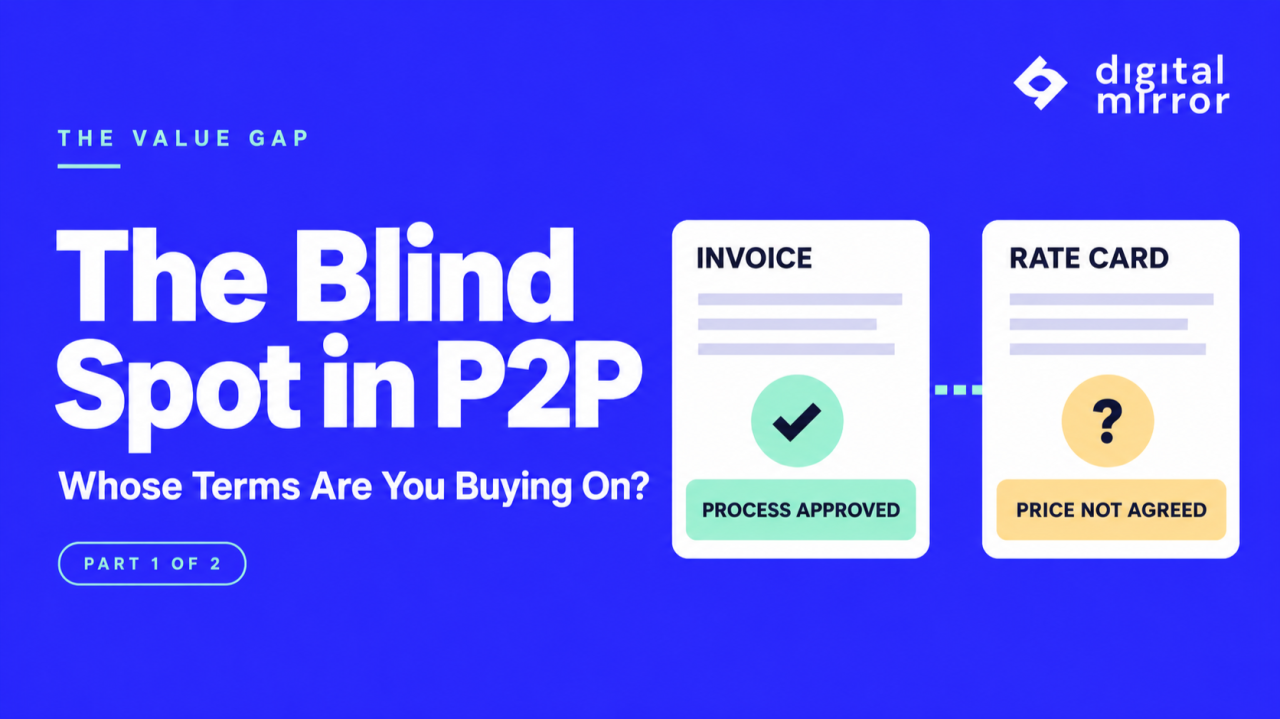
There is a fifth question. Do you know what your contracts entitle you to, and can you see whether your invoices reflect it?
That question is not addressed by hiring, because no team can manually review every contract against every invoice line. It is not answered by the systems you already own. Contract lifecycle management negotiates the agreement and stores it but never sees the invoice.
AP automation checks the invoice against the purchase order; it can only confirm that the invoice matches the PO. The ERP executes payment with no link between a contract clause and an invoice line. Spend analytics tell you where the money went but nothing about whether it should have gone there. Procure-to-pay runs on the purchase order throughout, but the PO shed the rebate tier, the index clause, and the service credit long before the invoice arrived.
Every one of those systems can be working correctly. Coverage, compliance, load, and adoption can all look healthy. The money leaves anyway.
Start with the diagnosis. Hire people to create commercial value. Deploy tools to remove friction. Redesign the process so that both hold. Outsource only the work that does not distinguish you. Then check that what you agreed is what you are paying, because none of the other four will do it for you. That is the final test: confirm the value first, then spend. When several constraints exist, fund the fix that closes the biggest value gap first.
The Value Gap is published monthly by Digital Mirror. Digital Mirror helps organizations unlock the value already hidden in their contracts. By connecting contract terms to real-world business outcomes, we help finance, procurement, and operations teams identify value leakage, improve working capital, recover missed savings, and ensure suppliers and customers deliver on what was agreed. Learn more at Digital-Mirror.ai