You negotiated the savings. Did you ever receive it?
Explore the risks in P2P processes that lead to value loss, and learn how to recover savings by aligning contracts with invoices effectively.
• 8 min read
Executive Summary
A procurement team negotiates a lower rate. The contract is signed, the savings go into the business case, and the sourcing project closes. From that point, the saving is largely assumed to take care of itself.
The trouble begins when the supplier starts invoicing. Because rates can vary by grade, location, volume, service, index, or contract year, each charge arrives with its own commercial logic, sometimes accompanied by a surcharge with rules of its own. Then there are the less obvious sources of error: an item altered in the ERP, an old rate surviving a contract renewal, or a discount threshold crossed without anyone noticing. As a result, small discrepancies can quickly accumulate into a material overpayment.
None of this changes the savings that were negotiated, but it often affects how much of those savings is actually realized once the invoices start arriving.
This makes rate checking via the invoice an unusually practical place to look for savings now.
There is no new deal to negotiate and no category strategy to wait for, because the commercial terms already exist and so do the invoices. The immediate task is to establish whether they reflect each other.
The rate card goes by many names
‘Rate card’ is convenient shorthand, although it is far from being a universal business term. Construction companies work with schedules of rates and unit rates, while professional-services firms may use rate cards or rate sheets. Shipping companies publish tariffs; cloud providers issue customer price sheets; healthcare uses fee schedules; and public procurement produces everything from pricing schedules to price matrices and framework prices.
The terminology changes partly because industries think about price differently. When the object being priced is measured work, rates come naturally. Access to a network or transport system tends towards tariffs, while a professional or clinical act becomes a fee. Metered consumption lends itself to price sheets, and framework procurement tends to produce schedules and matrices because individual prices sit inside a wider commercial structure.
Across the sectors examined in our research, those terms fall broadly into five families (schedule, rate, tariff, price and fee) without producing a single industry-independent name for the pricing mechanism itself.
What remains consistent is the economic purpose.
Somewhere in the commercial relationship there has to be an authoritative account of what may be charged. Sometimes it is a spreadsheet or contractual schedule; elsewhere the answer is distributed across several documents, or held as machine-readable customer pricing data rather than something anyone would recognize as a conventional document.
Finding the ‘rate card’, in other words, can be part of the problem.
The number is usually the easy bit
A straightforward price check sounds trivial: if the contract says $480 and the invoice says $520, query the difference.
Sadly, commercial pricing rarely behaves so politely.
In professional services, for example, the relevant rate may depend on the consultant's grade, capability, location and contract year, while some government schedules operate as ceilings rather than payable prices. Staffing can be complicated because the supplier charge may be calculated from the worker's pay, employment status and supplier fee instead of being copied from a single cell.
Construction presents a different problem. A unit rate becomes meaningful only after the work has been classified and measured correctly, which may mean establishing the schedule item, unit and quantity before determining whether an index, location factor or variation rule also applies.
Facilities management adds another question before price is considered at all: should the activity have been billed separately? Where a supplier receives a fixed price for planned services but has separate rates for reactive work, an invoice may use a valid rate for a task already included in the fixed service.
Freight works differently again, because the applicable amount can depend on lane, zone, service, weight, container or equipment type, together with surcharges that have their own rules and effective dates. A correct base freight rate therefore tells you surprisingly little about whether the complete invoice is correct.
Cloud and telecommunications turn much of the exercise into a data problem. Customer price, billing period, consumption tier, included quantity, unit of measure, SIM or meter and geographical zone may all determine what should have been charged.
A price can be genuine without being your price
The same principle appears elsewhere. A framework ceiling may not be the final call-off price, just as a guideline hourly rate is not necessarily the rate agreed with a particular client, and a catalog price need not be the contract price. Even a tariff can contain classifications and application rules alongside the numbers themselves.
The invoice can therefore be mathematically flawless and commercially wrong.
Why ordinary controls miss it
Most businesses already have substantial controls around purchasing and payment, but none was designed specifically to connect an invoice back to the commercial terms that govern it.
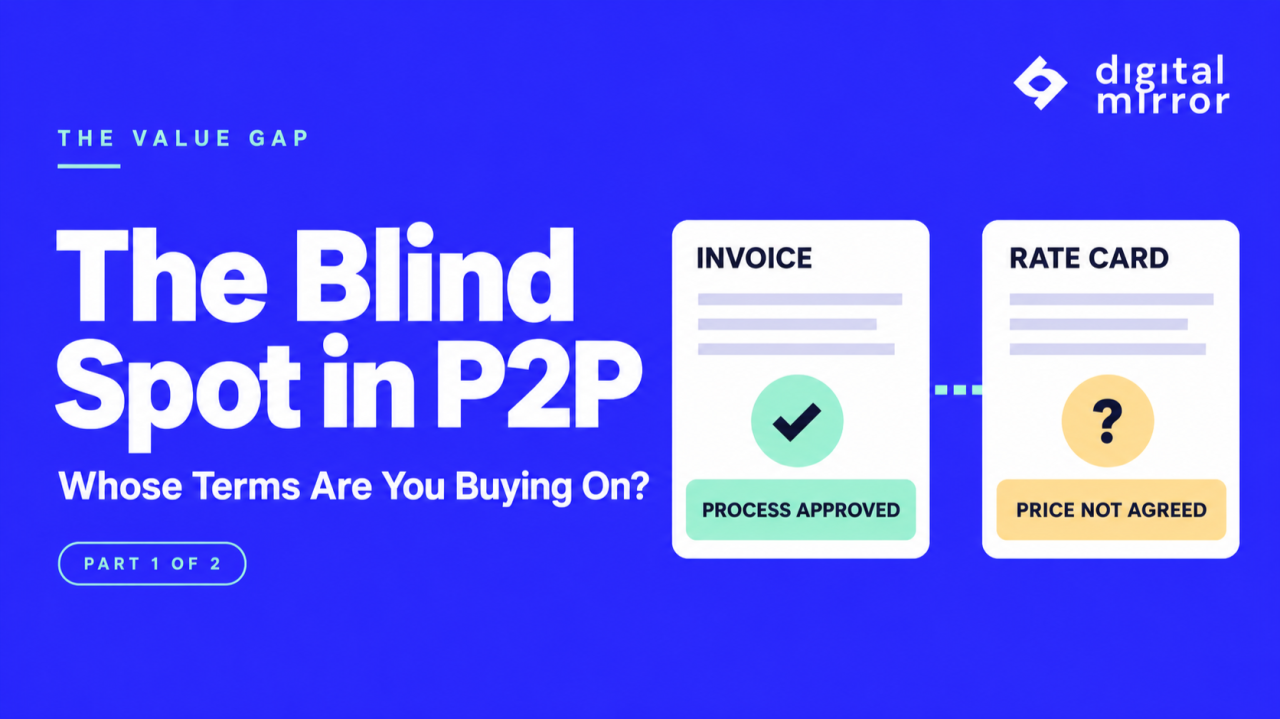
The contract system records what was agreed, while procure-to-pay manages the purchasing transaction and AP checks the resulting invoice against operational purchasing records. The ERP then executes payment and generates a spend analytics report of where the money went.
Each system can be doing its job correctly while the commercial error survives.
What is commonly absent is the link between the pricing rule negotiated months or years earlier and the individual charge being paid today. Issue 02 of ‘The Value Gap’ described the problem in those terms: CLM sees the agreement, but not the invoice; AP automation typically works against the purchase order; and spend analysis explains where the money went rather than whether the supplier was entitled to it.
As transactions move downstream, commercial detail tends to fall away. A negotiated rate becomes a PO price, while a rebate tier remains buried in the contract and an index rule sits in an appendix. Elsewhere, a rate ceiling may be mistaken for a payable rate. By the time the invoice arrives, several systems can agree with one another simply because they are all working from the same incomplete operational information.
The saving existed at negotiation. It simply failed to survive execution.
From negotiated value to realized value
Digital Mirror starts from that gap, working from the commercial documents themselves. It reads the agreed pricing terms and the invoices, then tests each line against the terms that govern it: which rate applied, under what conditions, during which period, and to which transaction.
Where a charge does not follow those terms, the finding keeps the evidence with it, down to the clause or the cell in the pricing schedule it came from.
As an example, our review of 15,000 subcontractor invoices at a construction company found confirmed errors in 6% of invoices. However, what matters is not that figure, but that the answer can be measured.
In another example, events that were never defined, rather than errors, had the biggest impact. A shipper was printing shipping labels incorrectly at several sites, so they had to be reprinted and reissued. A separate invoice was raised for this, but it was not tied to any specific shipment. On a sample of 1,000 transportation charges, this added $1 per shipment to costs, even though all the invoices were considered correct.
Start with what you already have
Many procurement savings programs begin with some future event, whether a tender, renegotiation, supplier consolidation, or transformation project. Checking what was charged against what was agreed is easier, because it can begin with the invoices already in the system.
A sensible starting point is a category where pricing is complicated, a group of suppliers where confidence is low, or a contract with enough transaction volume for small discrepancies to accumulate. Once you have chosen a defined invoice population, you can establish the commercial terms that govern it and compare the two.
That is a much smaller decision than launching an enterprise-wide program, and our own implementation approach reflects this: start with a defined invoice population, use the commercial documents the business already holds, and decide from the findings whether a wider exercise is justified.
Some apparent errors will prove legitimate, while others may expose master-data or process problems rather than supplier behavior. Some discrepancies, even when confirmed, may not ultimately be recoverable. Those qualifications actually make the initial measurement more important, because they allow finance and procurement to distinguish theoretical leakage from value that can actually be pursued.
Procurement has spent years becoming better at negotiating value.
The next question is whether the business received it.
Choose one area where the pricing is complicated enough that nobody can answer that question with confidence. Take the agreement, take the invoices, and test them. Quantify what is genuinely recoverable first, then decide whether the value gap is large enough to pursue the rest.
The Value Gap is published monthly by Digital Mirror. Digital Mirror helps organizations unlock the value already hidden in their contracts. By connecting contract terms to real-world business outcomes, we help finance, procurement, and operations teams identify value leakage, improve working capital, recover missed savings, and ensure suppliers and customers deliver on what was agreed. Learn more at Digital-Mirror.ai