Discover how organizations can enhance contract performance with a new maturity model that bridges the gap between contract management and measurable outcomes.
.png)
Introduction
Over the past decade, many organizations have invested heavily in Contract Management workflows and systems, resulting in faster approvals, standard terms, and improved version control. However, the real test for contracts is not whether they were created and approved more quickly, but whether they control what is delivered and billed effectively.
Supplier invoices arrive every month carrying the rates, quantities, and terms the supplier believes apply, so it is the one document that shows whether a negotiated term reached the ledger. In most organizations, nobody compares the invoice with the contract behind it. Contract Performance technology can close that gap, giving hard-pressed procurement and finance leaders the ability to ensure their supplier agreements deliver measurable, repeatable value.
The Analyst's View
We are not alone in this view. Research from Deloitte, McKinsey, and Gartner argues the same case: the next phase of contracting maturity must move beyond pre-signature to making the contract perform. World Commerce & Contracting and Deloitte examine the same gap in "The Purpose of Contracts" (2024); McKinsey’s April 2025 report Mitigating Procurement Value Leakage with Generative AI describes a pharmaceutical company that used AI invoice-to-contract reconciliation to uncover more than $10 million in value leakage; and Gartner’s 2025 Magic Quadrant for Contract Life Cycle Management (Nov. 2025) records AI as the main axis of competition in the category, with obligation management still appearing largely on vendor roadmaps rather than in shipped products.
Our Research
To better understand how organizations are progressing toward this goal, in July 2025 we surveyed 311 professionals in procurement, finance, and operations across North America and Europe. The results describe organizations where contracts are systematically captured and centrally managed, but performance remains largely unmanaged.
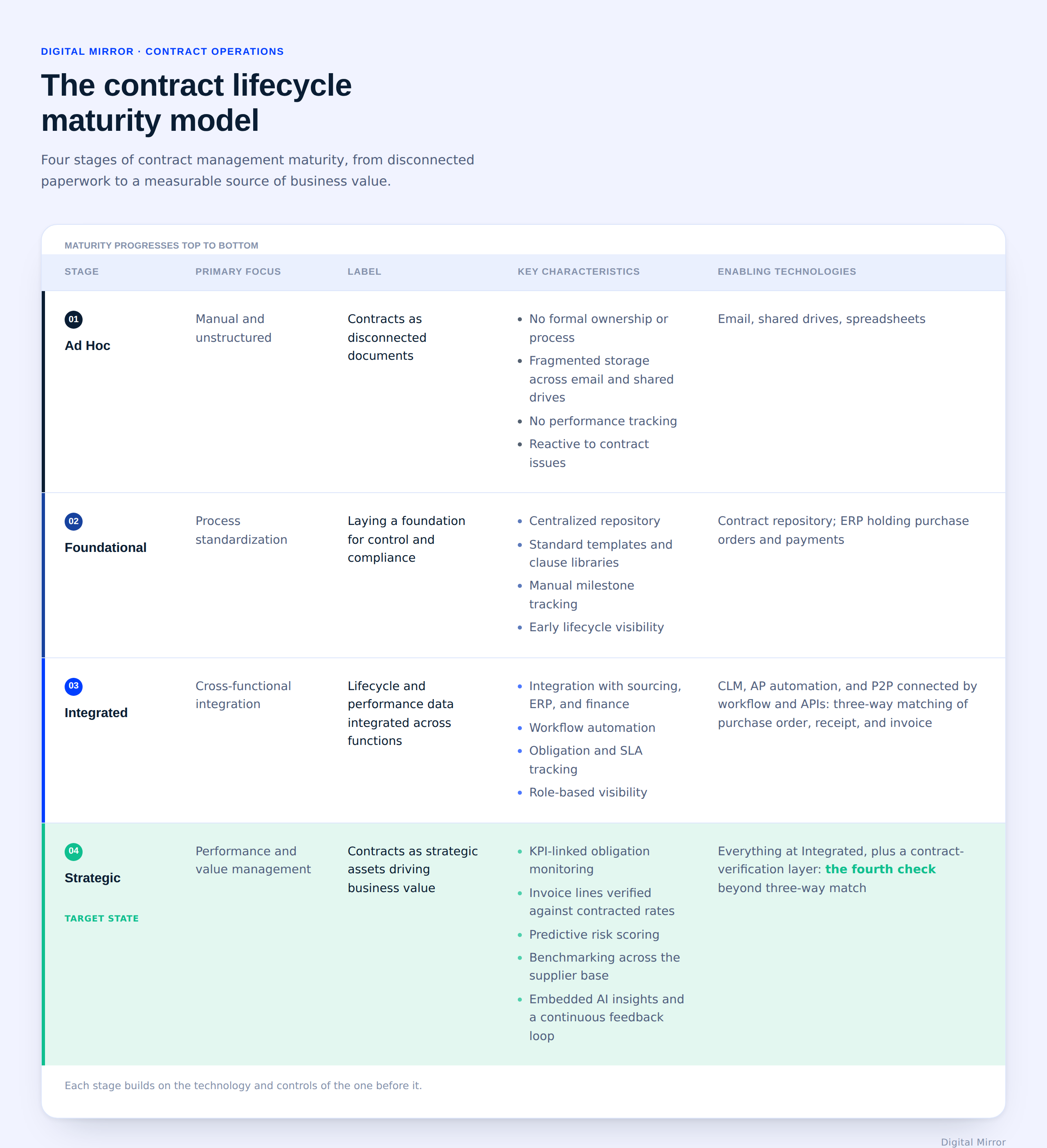
Based on these findings, we developed the Contract Performance Maturity Model (CPMM). The four-stage model reflects the realities uncovered in the research and gives organizations a path from document control to measurable outcomes. What the Survey Data Tells Us
1. Contract management ends where it should begin
When asked what "contract management" meant in their organizations:
- 72% cited storing and organizing agreements
- Only 28% mentioned active performance management
This reinforces a long-standing issue: contracts are often treated as static documents rather than instruments of ongoing commercial value. Without structured performance oversight, negotiated terms risk being ignored post-signature.
2. Contract Lifecycle Management (CLM) tools are widespread, but not sufficient
- 64% of respondents use a CLM system
- Yet 54% still rely on Excel or shared drives
- 60% report using internal or custom-built tools
The proliferation of CLM software hasn’t eliminated the reliance on manual processes. The post-signature phase (obligations, milestones, KPIs, and supplier accountability) remains fragmented, so many CLM deployments stop short of enabling performance insights.
3. Performance metrics are currently undervalued
When asked to prioritize contract goals:
- Volume discounts and rebates ranked #1 for 40% of respondents
- KPIs and SLAs ranked last for 28%, and first for only 8%
Financial impact understandably takes precedence. A volume discount is realized only when someone compares the contract threshold to the quantities billed, and Digital Mirror makes that comparison through Invoice-to-Contract Verification (ItCV).
However, ranking KPIs and SLAs last is a missed opportunity. KPIs and SLAs are early signals of supplier delivery issues, value leakage, or misalignment, and each one arrives later as a charge nobody challenged.
4. Supplier oversight is incomplete
- 17% of respondents were unsure how many suppliers they manage
- Others rely on informal processes or ad hoc tracking
Without a complete view of the supplier base or contractual obligations, performance cannot be consistently monitored. An organization that cannot count its suppliers cannot tell which of them are billing without an agreement at all.
An example from customer data
The survey describes what organizations believe about their contracts. Our customer data shows what turns up when someone checks. Across roughly 15,000 invoices from one customer over three months, about 6% carried errors the customer’s own review confirmed as real, and the value recovered was equivalent to one full-time employee in a single quarter. That was invoices checked against each other, before any contract entered the comparison.
Introducing the Contract Performance Maturity Model
The model combines what we learned building contract analytics at Seal Software with what the survey found. It measures how organizations manage post-signature performance, and it’s built specifically for procurement and finance teams, those closest to the money, supplier delivery, and commercial risk.
Four-Stage Contract Performance Maturity Model
Contract Discovery
Before performance can be tracked, obligations enforced, or value leakage addressed, organizations must first ensure they have a complete and accurate view of their active contracts. This foundational step, Contract Discovery, is essential, and we’ll be exploring it further in an upcoming blog series that examines how discovery enables confident decision-making, effective supplier management, and performance accountability.
A Note on Previous Models
Prior maturity models in contract management (the Garrett & Rendon Contract Management Maturity Model (CMMM) and CMMI for Acquisition) laid the groundwork in standardization, governance, and process maturity. These models were especially useful in regulated or defense-oriented contexts, where documentation, risk control, and policy compliance are paramount.
However, they tend to prioritize pre-signature activities and process efficiency over post-signature performance. Few provide a structure for managing supplier delivery, financial realization, or obligation tracking across complex, global supply bases.
The model we propose addresses that gap by treating contract performance as a source of commercial value, so procurement and finance can see whether what was signed is what was billed.
Bridging the Gap Between Contracts and Performance
We built the model from the survey data, and it aligns directly with the realities the survey uncovered:
-
Stage 1 (Ad Hoc) is the 17% who cannot say how many suppliers they manage. With no system of record, there is no count to give.
-
Stage 2 (Foundational) is the 54% still working from Excel and shared drives, and the 72% who define contract management as storing and organizing agreements. The repository exists; nothing has moved past it.
-
Stage 3 (Integrated) addresses the need for visibility across finance, sourcing, and supplier systems.
-
Stage 4 (Strategic) is the 8% who rank KPIs and SLAs first, and where the commercial value sits.
It also provides a simple language and structure for benchmarking progress, identifying gaps, and building a roadmap toward outcome-driven contract management.
Conclusion
Our research shows that contract performance remains unmanaged in most organizations. The gap between documentation and delivery is where procurement and finance leaders have room to act, and it can now be checked rapidly, without disruption.